
What Is Granite Stone and How Is It Transformed into Countertops?
Granite has long been regarded as one of the most durable and visually striking natural stones used in architecture and interior design. From ancient monuments to modern kitchens, granite’s strength, beauty, and longevity have made it a preferred material across civilizations. But what exactly is granite, and how does it make the journey from the earth to a finished countertop in your home?
What Is Granite?
Granite is a natural igneous rock formed deep within the Earth’s crust over millions of years. It is created when molten magma slowly cools beneath the surface, allowing large mineral crystals to form. This slow cooling process is what gives granite its distinctive granular appearance and exceptional hardness.
The primary minerals found in granite are quartz, feldspar, and mica. Quartz contributes to granite’s strength and resistance to scratching, feldspar provides a wide range of colors—from whites and grays to pinks and blues—and mica adds subtle sparkle and depth. Because granite is a natural material, no two slabs are exactly alike, making each countertop truly unique.
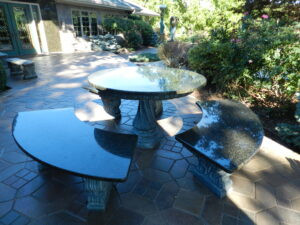
Quarrying Granite from the Earth
The transformation of granite into countertops begins at quarries, where large granite deposits are extracted from the earth. Modern quarrying techniques use diamond wire saws, drills, and controlled cutting methods to remove massive blocks of stone while minimizing waste and environmental impact.
Once extracted, these blocks can weigh anywhere from 10 to 30 tons. They are inspected for quality, color consistency, and structural integrity before being transported to processing facilities. At this stage, the granite is still raw and rugged, far from the polished surfaces seen in kitchens and bathrooms.
Cutting Blocks into Slabs
At the processing plant, granite blocks are sliced into slabs using large industrial saws equipped with diamond blades. These slabs are typically cut to a thickness of 2 or 3 centimeters, which is standard for countertop applications.
After cutting, the slabs undergo a surface treatment process. This often begins with resin application, which fills natural fissures and strengthens the stone. The slabs are then cured and polished through a series of progressively finer abrasives. Polishing brings out the stone’s natural colors, veining, and luster, resulting in the glossy or honed finish customers recognize.

Fabrication into Countertops
Once polished, granite slabs are shipped to fabrication shops, where they are custom-cut into countertops based on precise measurements from the installation site. Using CNC machines and skilled craftsmanship, fabricators cut sink openings, edge profiles, and seam placements to match the design specifications.
Edges can be finished in various styles, such as eased, beveled, bullnose, or ogee, depending on the desired aesthetic. Each cut is carefully refined, and exposed edges are polished to match the surface finish of the slab.
Installation and Final Touches
After fabrication, the granite countertops are transported to the project location for installation. The pieces are leveled, secured, and seamed together using color-matched epoxy for a seamless appearance. Once installed, the surface is cleaned and sealed.
Sealing is an important final step, as it helps protect the granite from staining while maintaining its natural breathability. With proper care and periodic resealing, granite countertops can last for decades.
Why Granite Remains a Top Choice
Granite’s journey from deep within the earth to a finished countertop is a testament to both nature and craftsmanship. Its durability, heat resistance, and timeless beauty make it a practical and elegant choice for kitchens, bathrooms, and commercial spaces alike.
Each granite countertop tells a geological story millions of years in the making—one that continues to add value, character, and performance to spaces around the world.
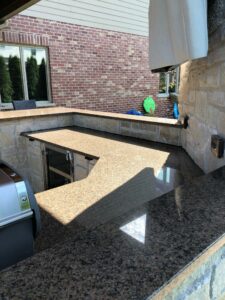
Granite is a product of nature and is completely resistant to the elements. Thus, it is the product of choice for outdoor kitchens and projects. Need a picture of outdoor kitchen.
GMD Surfaces Program
GMD Surfaces has several granite program colors. These colors are some of the most popular and beautiful colors available on the market. The prices vary depending on the design. Consistent colors are less attractive and therefore are in less demand and sold at a lower price point. Conversely, colors that are veinier are more unique and beautiful and in demand. These colors vary from slab to slabs and no two-granite owners have the exact same design. Therefore, these colors are in higher demand and more expensive. Visit our granite page to view our program colors and visit our Live Inventory to view more colors in stock.
Granite has been popular for a long time and continues to be a very color option for homeowners. GMD Surfaces installed thousands of kitchen and bathroom countertops since our establishment in 2007. These projects are spread out all the across the city of Chicago and its suburbs such as Oak Brook, Hinsdale, Clarendon hills, Burr Ridge, Orland Park, Frankfort and other suburbs. Granite is also a popular option for homeowners in northwest Indiana in towns such as Saint John, Schererville, Crown Point, Valparaiso and Michigan City.
Visit our showroom in Mokena Illinois and view the many colors in full size slabs at our warehouse.